


Crete has no shortage of photogenic scenery on land. But the most striking compositions on the island are the ones most visitors never see, because they require a boat to reach. Turquoise lagoons framed by white sand, Venetian fortresses rising from bare rock, and cliff faces that glow amber at sunset are all waiting just offshore, invisible from the road.
This guide covers twelve spots around the Cretan coastline that consistently produce the kind of photographs people stop scrolling for. Every location on this list is best reached, and best photographed, from the water. Some are accessible on a morning cruise, others require a full-day route, and a few only reveal their best angle during the final hour of daylight. If you are planning a trip to Crete and photography matters to you, these are the frames worth building a day around.
Written by Elena Markou for the DanEri Journal using real cruise routes, active DanEri imagery, and on-the-water photography experience as of April 17, 2026. Every spot listed here is reachable on a DanEri departure.
West Crete: The Bucket-List Frames
1. Balos Lagoon From Above
Balos is the photograph that sells Crete to the world, but the version most people see is taken from the hillside trail. The angle from the sea is different and, for many photographers, stronger. Approaching by catamaran, you get the full gradient of the lagoon laid out in front of you: white sand splitting two bodies of water, one pale green, the other deep blue. On a calm morning the surface is so still it looks like a watercolor painting. The Morning LUX cruise from Kissamos at EUR 135 puts you in the lagoon before the midday crowds arrive, which means cleaner compositions and softer light.
2. Gramvousa Fortress
The Venetian fortress on Gramvousa sits on a rocky outcrop that looks almost artificial in its drama. From the water, the structure dominates the frame with nothing but sky and sea behind it. Shoot from the starboard side as the catamaran rounds the island and you will catch the fortress walls catching direct morning light. It is part of the same Kissamos route as Balos, so you get both locations in one booking.

Gramvousa fortress from the sea: one of the most dramatic compositions in all of western Crete.
3. Chania Venetian Harbor At Sunset
The old harbor in Chania is beautiful from the waterfront, but the angle from the sea is what transforms it into something cinematic. As the sun drops behind the White Mountains, the lighthouse, the mosque, and the pastel facades all catch warm light simultaneously. It is one of those rare compositions where every element lines up at once. The Sunset Chania cruise at EUR 85 is timed specifically for this golden-hour window, and the deck of the catamaran gives you an unobstructed, slightly elevated perspective that no restaurant terrace can match.
The Chania harbor sunset is one of Crete's most photographed moments, but the best angle is from the water.
4. Agioi Theodoroi Islands
The twin islands off the Akrotiri Peninsula are a protected wildlife area, which means no foot traffic and no development. From the water, they look like green domes floating on glass. The islands are home to the Cretan wild goat, the kri-kri, and if you are lucky you will spot one standing on the cliff edge. The undisturbed quality of these islands gives your photographs a timelessness that busier locations cannot offer.
Central Crete: Hidden Coves And Volcanic Drama
5. Bali Bay Coves
Bali Bay is a series of small coves tucked into the north coast between Rethymno and Heraklion. From land, you see one beach at a time. From the water, the entire sequence unfolds as a single panoramic composition: layered cliffs, tiny beaches, and water that shifts from emerald to sapphire depending on the depth. The sheltered nature of the bay means the surface is often perfectly calm, which creates mirror-like reflections ideal for symmetry shots.

Bali Bay's layered coves produce some of the most naturally symmetrical compositions on the north coast.
6. Dia Island Cliffs
Dia is the uninhabited island directly north of Heraklion. Most visitors see it as a hazy shape on the horizon from their hotel balcony. Up close, the cliffs are strikingly vertical and richly textured, with bands of ochre, grey, and white rock. Seabirds nest in the crevices, and the water below is a deep, ink-like blue. If you are looking for raw, dramatic landscape photography without any human element, Dia delivers consistently.
7. Spinalonga Island Approach
Spinalonga is famous for its history as a leper colony, but the photograph that resonates most is the approach. As your vessel rounds the headland, the fortified island appears suddenly, its walls rising directly from the water. The composition works because of the contrast between the warm stone of the fortress and the cool Aegean blue surrounding it. Morning light from the east catches the walls perfectly, and the approach by boat creates a sense of arrival that no telephoto shot from the mainland can replicate.
The approach to Spinalonga is one of Crete's most cinematic moments, best captured from a moving vessel.
South And East Crete: Turquoise Extremes
8. Chrissi Island Turquoise Shallows
Chrissi is the island that makes people question whether they are still in Europe. The water is Caribbean-clear, the sand is made partly of crushed shells, and the juniper forest behind the beach gives the horizon an unusual texture. From a boat, you can photograph the full gradient from deep blue to almost transparent turquoise as the seabed rises toward shore. The Chrissi cruise from Ierapetra at EUR 115 gets you there with time to swim and shoot before the midday light flattens the colors.
9. South Coast Sea Cliffs
The south coast of Crete between Sfakia and Loutro is one of the most vertically dramatic coastlines in the Mediterranean. Cliffs drop hundreds of meters straight into the sea. From a boat, you can photograph entire mountain faces reflected in deep water, with no roads, no buildings, and no other boats in the frame. It is the kind of landscape that looks almost Scandinavian in its scale, except the water is warm and the light is golden.
The south coast cliffs near Sfakia produce landscape photography that feels closer to Norway than the Mediterranean.
10. Koufonisi Island Ruins
Southeast of Ierapetra, the uninhabited island of Koufonisi holds the remains of a Roman amphitheater just meters from the waterline. The combination of ancient stone, turquoise shallows, and absolute solitude creates a visual mood that is impossible to find on the mainland. Approach by boat and you can frame the ruins against open sea with no modern context in the shot.
11. Elafonisi Pink Sand Shores
Elafonisi is famous for its pink-tinted sand, but from the shore the color is subtle. From the water, the contrast is amplified. You see the pale pink sand against bright turquoise shallows, and the wide sandbar that connects the islet to the mainland becomes a compositional dividing line that splits the frame beautifully. Shoot from a slight distance and the pink becomes unmistakable.
12. Marathi Bay At Dawn
Marathi is a small bay on the Akrotiri Peninsula near Chania that most visitors drive past on the way to Stavros. From the water at dawn, the bay is glass-still and the fishing boats moored inside create perfect reflections. It is a quieter, more intimate photograph than the big-name spots, but it captures something essential about Crete: the calm, the color, and the feeling that you have arrived somewhere that does not need to try.
Every one of these twelve locations shares a single quality: the best angle is only available from the water. A boat is not just transport here. It is the camera platform that unlocks the composition.
Photography Tips For Shooting From A Boat
- Shoot during golden hour. The first and last ninety minutes of sunlight produce the warmest tones and the longest shadows on cliff faces. Morning cruises and sunset departures are designed around these windows.
- Waterproof your phone. A simple waterproof pouch rated to IPX8 costs under ten euros and means you can shoot from the swim platform, the bow, or even while snorkeling without worrying about spray or accidental drops.
- Use burst mode on approaches. The best compositions from a moving boat appear and disappear in seconds. Burst mode lets you capture the exact moment a fortress, cliff, or lagoon aligns in the frame.
- Know the drone rules. Greece requires registration and permits for drone flights. National parks, archaeological sites, and military zones are no-fly areas. Balos and Gramvousa fall within restricted airspace, so check current regulations before packing your drone.
- Bring a polarizing filter. Even a clip-on phone polarizer will cut the surface glare and let you capture the true color of the water below, especially useful over the shallow turquoise areas at Balos, Chrissi, and Elafonisi.

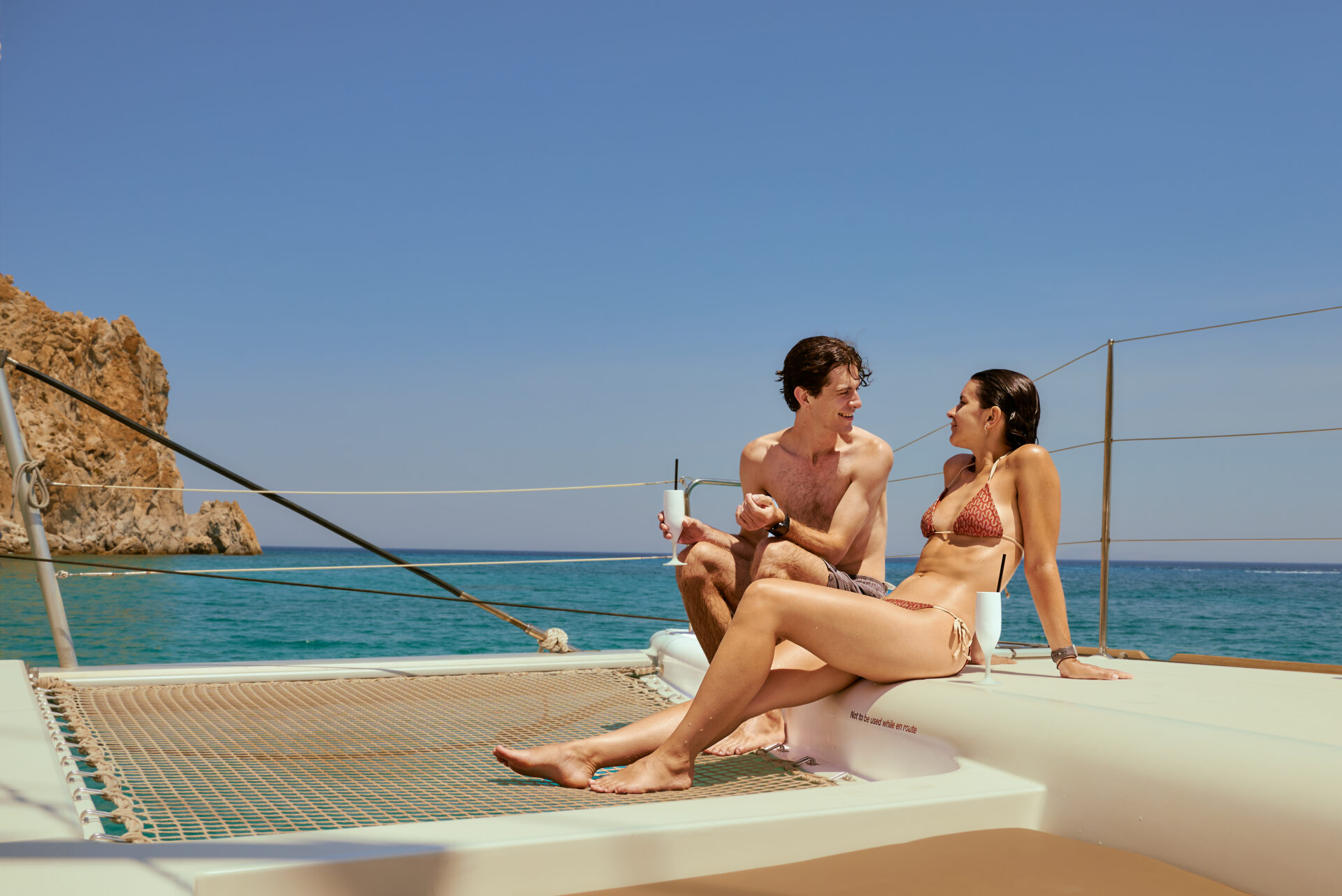
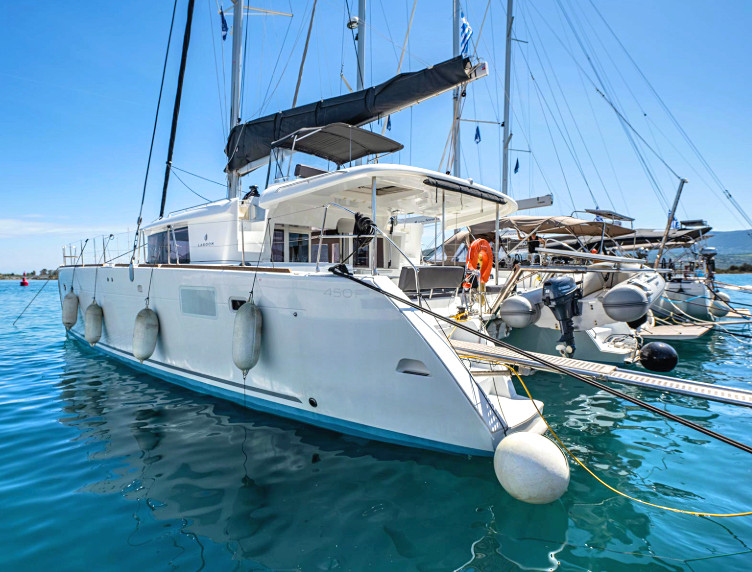
The deck of a catamaran gives you a stable, elevated platform that no shoreline can replicate.