

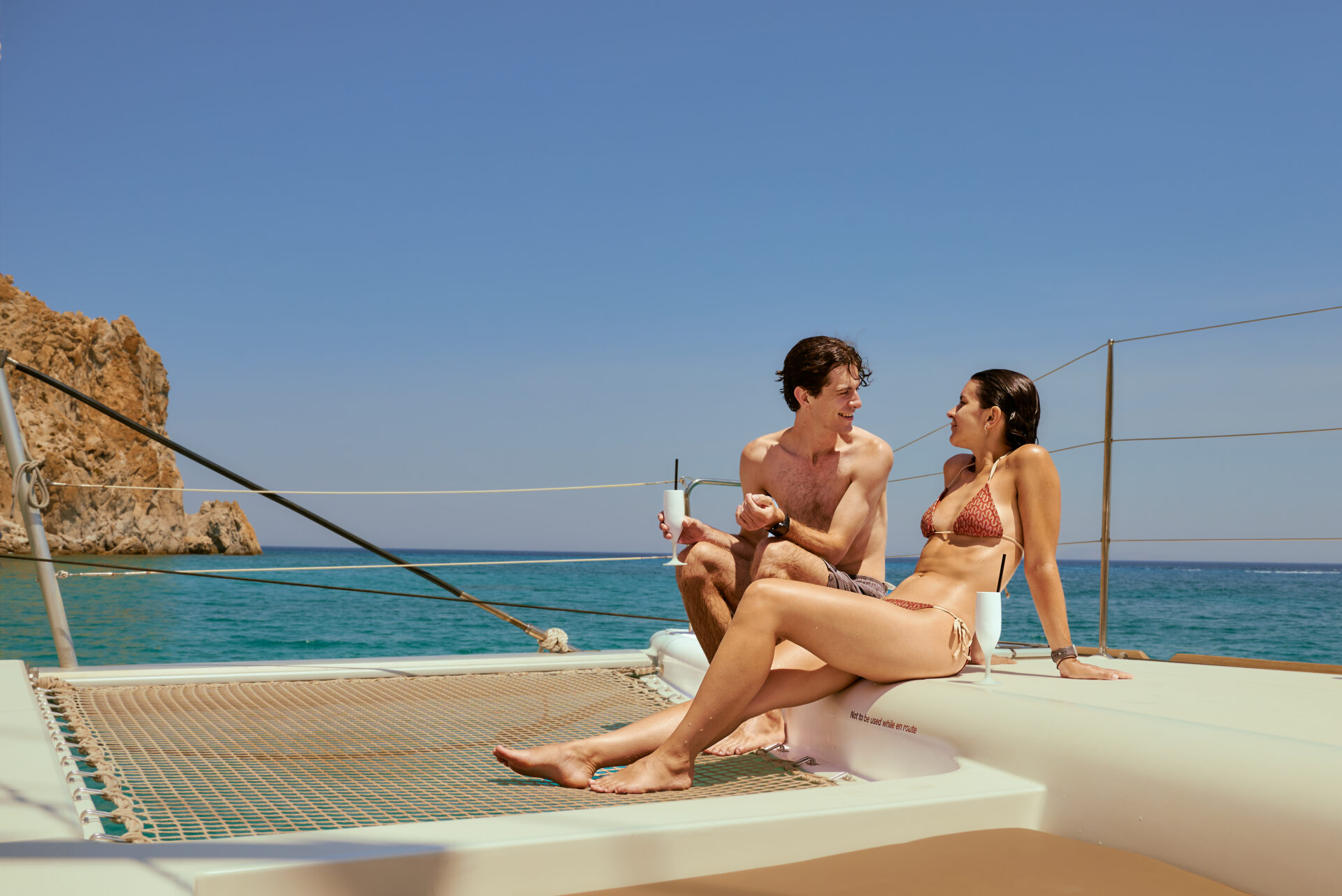
Most visitors to Crete walk past the entrances without knowing they exist. From a beach towel or a clifftop road, there is nothing to see except rock and surf. But approach the same coastline from the water and entire chambers open up: blue-lit caverns wide enough to swim through, walls crusted with marine life, and sheltered pools where the sea turns from dark Aegean blue to electric turquoise in the space of a few meters.
These are the swimming caves of Crete, and they are one of the strongest reasons to book a boat day rather than another beach transfer. You cannot hike to most of them. You cannot see them from the road. They exist entirely for the guests who arrive by sea, and they transform a standard cruise into something that feels genuinely exploratory.
Written by Elena Markou for the DanEri Journal using current route information, active cruise pages, and DanEri imagery as of April 17, 2026. Every cave location described in this article is a real swim stop on an active DanEri route.
Three DanEri routes include cave swim stops: the Dia Island cruise from Heraklion for volcanic sea caves, the Bali Bay cruise from Panormo for cliff-base grottos, and the Morning LUX from Kissamos for the dramatic south-coast and western cave formations.
Why Crete's Best Caves Are Invisible From Land
The geology that makes Crete's coastline so dramatic is the same geology that hides its finest swimming spots. Limestone and volcanic rock erode unevenly. The sea carves horizontally into cliff bases, creating openings that face the water rather than the shore. From above, the cliffs look solid. From a boat floating twenty meters out, the dark mouths of the caves become unmistakable.
This is not a minor detail. It is the entire reason these caves feel so rewarding to visit. There is no crowd, no boardwalk, no entrance fee. You swim in from the catamaran, and you are inside a space that most of the island's visitors will never know exists. The light changes from white to blue as you pass the entrance. The water temperature drops slightly. The sound shifts from open sea to an enclosed, echoey stillness. It is one of the most distinctive sensory experiences available on a Crete holiday.
Inside the volcanic caves near Dia Island, the water shifts to a luminous blue that only appears when sunlight refracts through the submerged entrance.
The Dia Island Caves: Volcanic Chambers Off Heraklion
Dia is a small uninhabited island visible from the Heraklion waterfront. Most visitors assume it is just a rocky outline on the horizon. In reality, the island's northern and western faces are riddled with sea caves carved into volcanic rock, and the Dia Island cruise from Heraklion (from €85) stops at the best of them.
What makes the Dia caves special is the volcanic stone itself. Unlike the pale limestone caves you find elsewhere on Crete, these chambers have darker walls with streaks of red and ochre. When sunlight enters at the right angle, the water inside turns an intense cobalt blue that looks almost artificial. The caves are deep enough to swim into comfortably but shallow enough that you can see the sandy bottom in most places.
Snorkelers get even more from this stop. The cave walls host sea urchins, small fish sheltering in the crevices, and patches of orange and purple sponge that thrive in the low-light environment. The water clarity around Dia is exceptional because the island sits far enough offshore to avoid the sediment that sometimes clouds near-shore areas.

The Dia Island route from Heraklion reaches the cave swim stops within 40 minutes of departure, leaving plenty of time for exploration.
The Bali Bay Cliff Caves: Sheltered Grottos Along The North Coast
The coastline between Panormo and Bali is a wall of eroded cliff faces punctuated by small coves and hidden inlets. The Bali Bay cruise from Panormo (from €95) navigates this stretch slowly, and the captain knows exactly where the best cave openings sit.
These caves are different from the Dia formations. The rock here is pale limestone, and many of the grottos are partially open to the sky. That means the light inside is softer and more diffused, creating a blue-green glow rather than the deep cobalt of volcanic chambers. Some of the Bali cliff caves have small pebble beaches at their back walls where you can actually stand and look out through the cave mouth at the catamaran floating in the bay.
What Makes The Bali Caves Ideal For Families
The water inside these grottos is typically calmer than the open sea because the cliff walls act as natural breakwaters. That makes the Bali cave stops particularly comfortable for less confident swimmers and for families with children. You can float in warm, sheltered water while the more adventurous members of your group explore deeper into the rock formations.

The limestone cliff caves near Bali Bay offer calm, sheltered swimming inside formations that are invisible from the coastal road above.
- Dia Island caves offer volcanic rock, deep blue light, and exceptional snorkeling along dark chamber walls.
- Bali Bay cliff caves offer pale limestone, softer light, calmer water, and hidden pebble beaches inside the formations.
- South and west coast caves on the Morning LUX route offer the most dramatic scale, with tall arched openings and deep swim-through passages.
The South Coast And Western Caves: Morning LUX From Kissamos
The largest and most dramatic cave formations on Crete sit along the south coast and the western shoreline near the Gramvousa peninsula. The Morning LUX cruise from Kissamos (from €135) reaches these waters as part of its flagship west-Crete route, and the cave stops here feel like a different category entirely.
The scale is what sets these caves apart. Some of the openings are tall enough for the catamaran to approach within meters of the entrance. Inside, the chambers extend much deeper than the Dia or Bali formations, and several feature swim-through passages that connect one cave to the next. The rock here is a mix of limestone and harder metamorphic stone, which creates dramatic colour contrasts in the walls: white, grey, and rust-orange layered in visible geological strata.

The western cave formations near Gramvousa are among the tallest and most dramatic accessible by boat on the entire island.
For snorkelers, the south-coast caves are the most rewarding. The deeper water and stronger currents bring more marine life to the cave mouths, including schools of damselfish, the occasional octopus tucked into a crevice, and dense patches of neptune grass just outside the entrances. The visibility here can exceed fifteen meters on calm days.
Safety Tips For Swimming In Sea Caves
Cave swimming on a DanEri cruise is supervised and the captain selects stops based on current sea conditions. That said, a few practical notes will help you get the most from the experience.
- Always enter and exit caves with a buddy. Even in calm conditions, it is smarter to swim in pairs so someone can signal the boat if needed.
- Wear reef-safe sunscreen before the cave stop, not inside the cave. Applying sunscreen in enclosed water concentrates chemicals in a small area.
- Bring a mask and snorkel. The cave walls are the most interesting part, and you will miss the marine life entirely if you are only looking at the surface.
- Do not touch the cave walls or ceiling. The formations are fragile, and sea urchins can be present on surfaces that look smooth from a distance.
- Listen to the crew. If the captain says a particular cave is not suitable on a given day due to swell or current, that decision is final and it is made for your safety.

A mask and snorkel transform the cave stops from a quick swim into a genuine underwater experience along the chamber walls.
Which Route Should You Book For Cave Swimming?
The answer depends on your base and your priorities. If you are staying in Heraklion and want the most accessible cave experience with strong snorkeling, the Dia Island route is the natural choice. If you are based in Rethymno or Panormo and want sheltered, family-friendly cave stops as part of a relaxed north-coast day, Bali Bay is the right booking. And if you are willing to commit to a full west-Crete day and want the most dramatic cave scale on the island, Morning LUX from Kissamos delivers the biggest visual payoff.
Tell the DanEri team that cave swimming is a priority when you enquire about your booking. The captain can adjust the stop sequence to maximise your time at the best cave locations for the conditions on your sailing day.

Every DanEri route that includes cave stops allows time for swimming, snorkeling, and exploring the formations at your own pace.