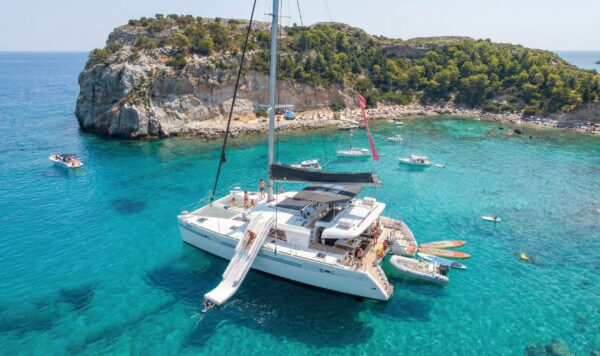
Anthony Quinn Bay is a small emerald cove on the east coast of Rhodes, about 4 km south of Faliraki and 20 minutes by road from Rhodes Town. It is named after the Hollywood actor who fell for it while filming The Guns of Navarone in 1960. It has the clearest snorkelling water on the island, almost no sand, and a beach so small it fills by mid-morning in July and August.
I anchor off it several times a week between April and October. So here is the honest version most beach guides won’t give you: the bay is genuinely one of the most beautiful spots in the Aegean, but the experience you get depends entirely on whether you arrive from the road above or from the water. From the cliff, you fight for a pebble and a parking space. From the deck, you swim straight onto the snorkel lines before the land crowds even wake up.
Written by Captain George Bantis, who runs DanEri’s Rhodes base and captains the day cruise past Anthony Quinn Bay most days in season — a vantage point most writers covering this beach don’t have.
The Guns of Navarone story — the real one
In 1960 the production of The Guns of Navarone took over Rhodes for the best part of three months. Lindos, the Acropolis above it, the Old Town, the Grand Master’s Palace, Kallithea — the island stood in for the fictional German-held island of “Navarone”. Anthony Quinn, who played the Greek resistance fighter Andrea Stavrou, spent that summer here and fell for a quiet cove on the east coast.
Here is where the myth and the facts part company. The popular version is that Quinn simply “bought the bay”. What actually happened is messier and, I think, more interesting: Quinn acquired and was promised land around the cove — partly purchase, partly a gesture of thanks for the publicity the film brought Rhodes — and he spent the better part of four decades trying to hold onto it through the courts. The litigation outlasted him. The land was ultimately ruled to remain in public hands, which is exactly why you can swim there today for the price of a lounger.
“Anthony Quinn Bay” commemorates a love affair with a piece of coastline that, legally, was never his to keep. Locals still mostly call it by its older name, Vagies.
The cove was shaped to be seen from sea level — not from the viewpoint on the road above.
What the bay is actually like
Picture a narrow inlet maybe 250 metres long and, at its widest, only about ten metres of shore. The “beach” is pebble and rock, not the fine sand you get at Faliraki up the coast. Dark green pines and scrub come right down to the waterline, and that vegetation is what gives the water its colour — a deep, mineral emerald-green that shifts to turquoise where it shallows over the rocks.
The water drops away fast. Two or three strokes off the shore and you’re in seven or eight metres of beautifully clear sea. On a calm morning visibility is genuinely 12 metres or more — you can watch your own shadow track across the rocks below. That steep, rocky profile is exactly why the snorkelling here beats anywhere else on Rhodes, and also why it isn’t the right beach for toddlers paddling at the edge.
At the top of the access stairs there’s a small bar-restaurant for drinks and a bite. Loungers and umbrellas run roughly €6–€10 a person, and they’re worth it — there’s little natural shade because the pines sit back from the water, and towel space is limited. That’s the whole infrastructure — this is a swim-and-snorkel cove, not a resort beach.
Snorkelling: where the good stuff is
This is the part the land guides skim. The rocky seabed and the way the cove shelters from the prevailing meltemi wind create natural caves, ledges and fish-friendly corners. Work along the right-hand cliff as you face the sea and you’ll find the seabed dropping in steps, with bream and wrasse holding tight to the rock and the occasional octopus tucked into a crevice. There’s a small overhang near the seaward end of that wall that you can really only reach comfortably by swimming in from a boat — from the beach it’s a long, deep paddle.
A practical word the postcards skip: the rocks are sharp and, by midday, genuinely hot underfoot. Almost every visitor review of this beach says the same thing — bring water shoes. If you’re coming on our cruise we hand them out for the swim platform; if you’re walking down from the road, pack a pair. There’s also a small dive centre at the bay if you’d rather go below snorkel depth with a tank.
A morning at the bay, from the deck
Let me tell you what this actually looks like, because I see it most mornings and the photos never quite catch it. We come around the headland from Ladiko at about half past ten, and there’s always a moment when the whole boat goes quiet — the cove opens up, the green wall of pines drops straight into water the colour of bottle glass, and somebody on the bow says “oh, wow” before they can stop themselves. It happens almost every day. I’ve stopped getting tired of it.
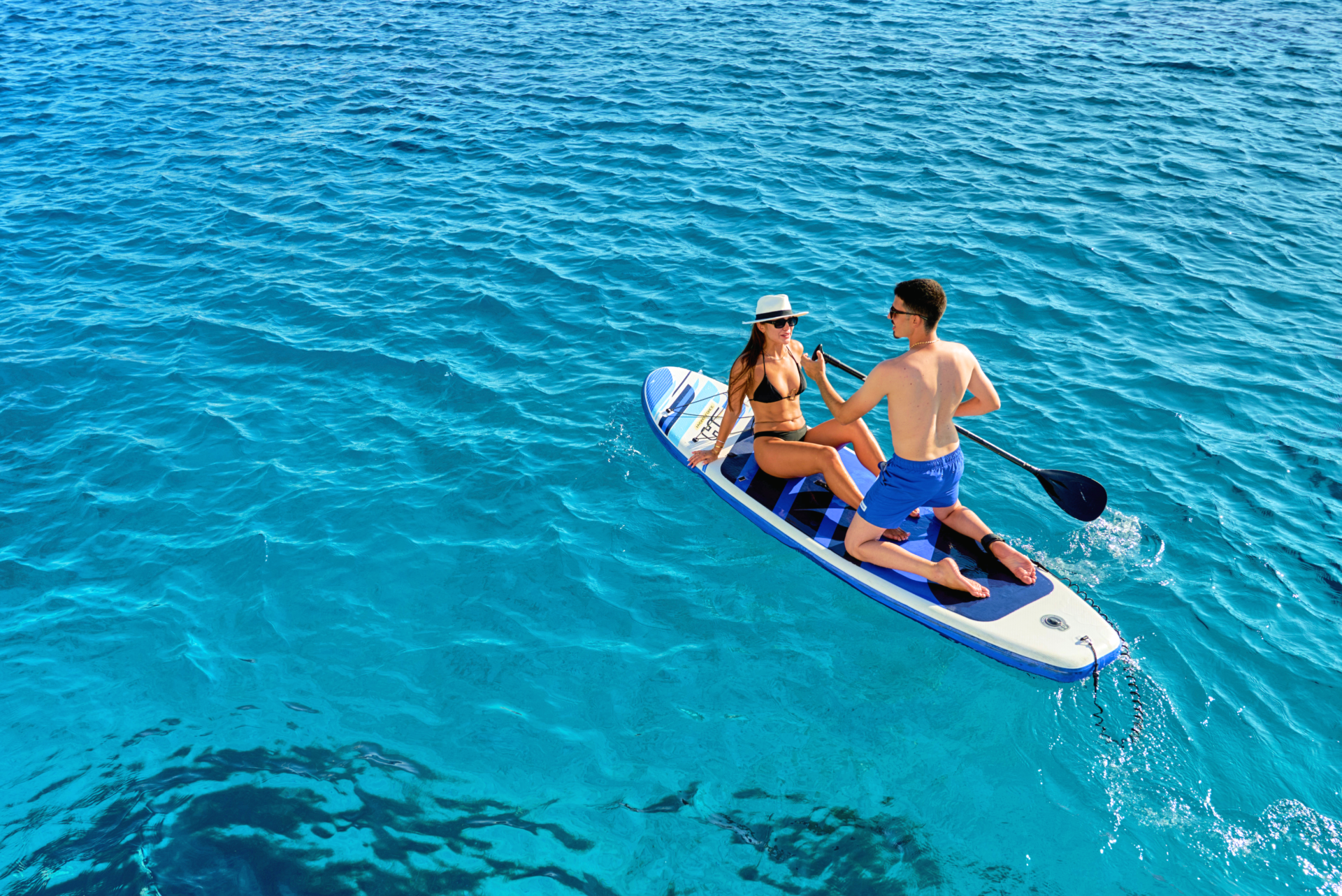
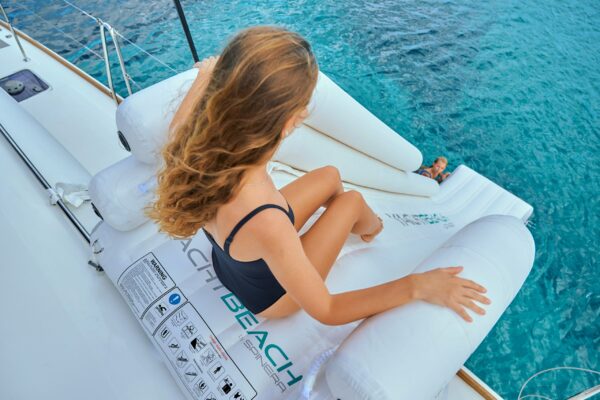
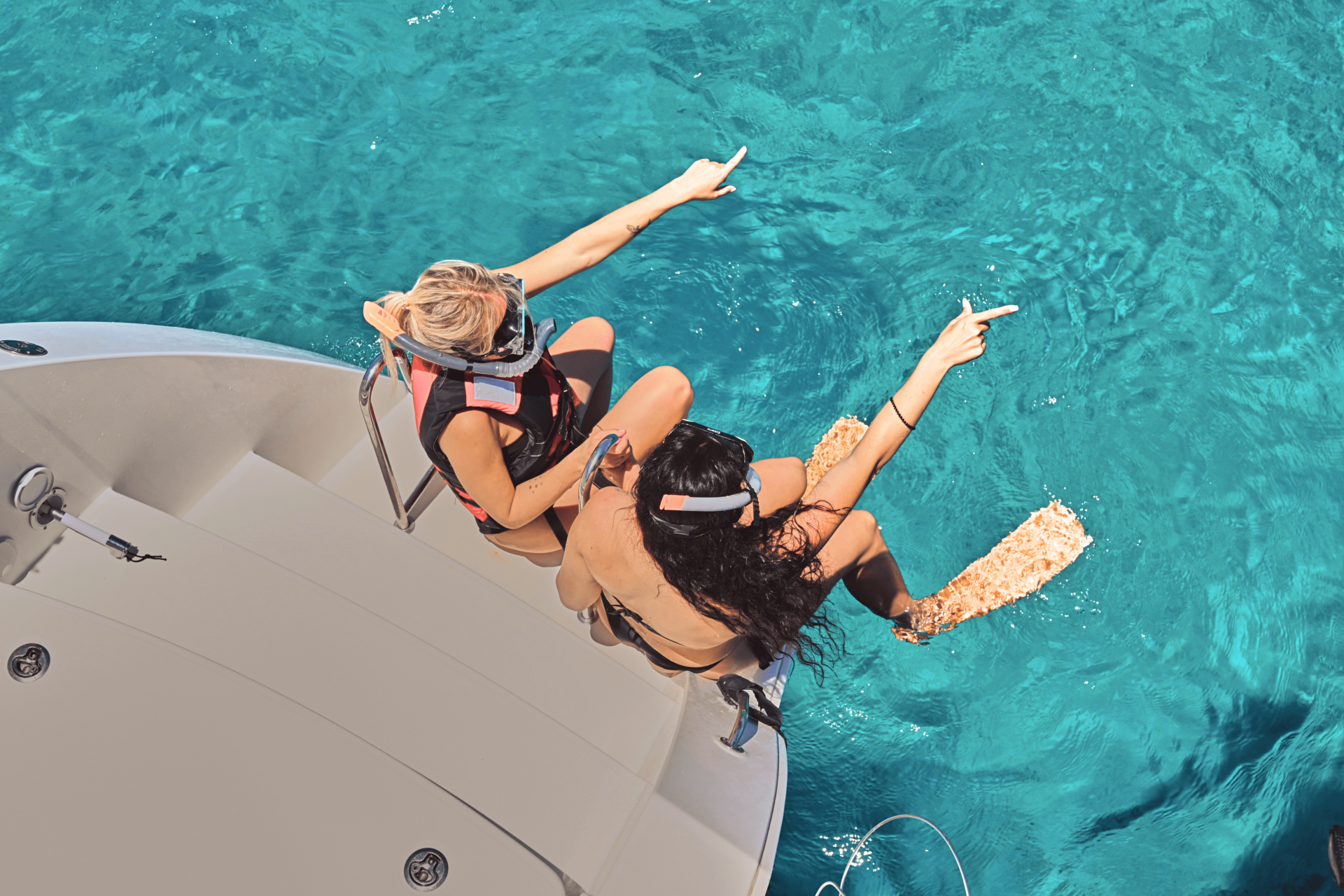
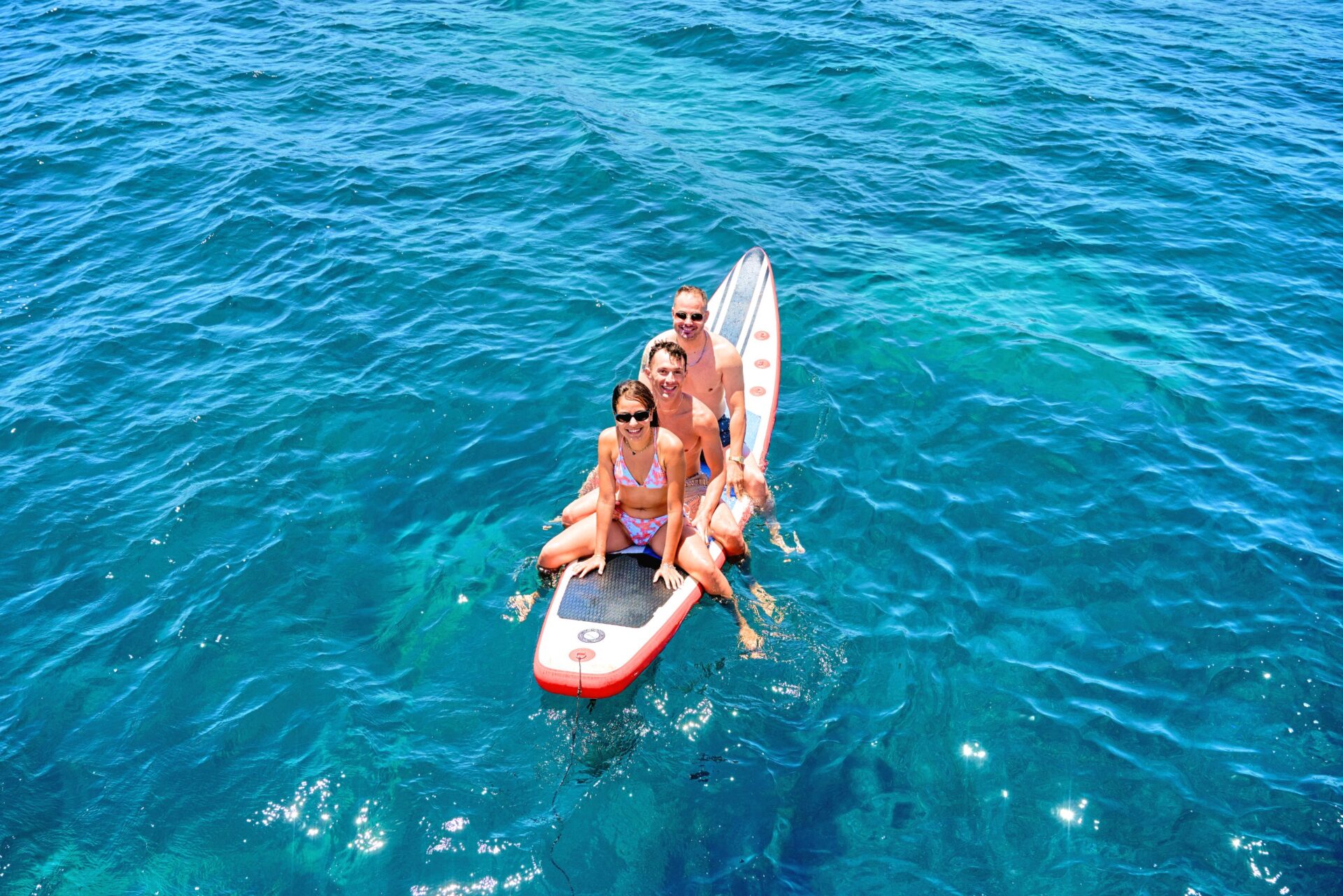
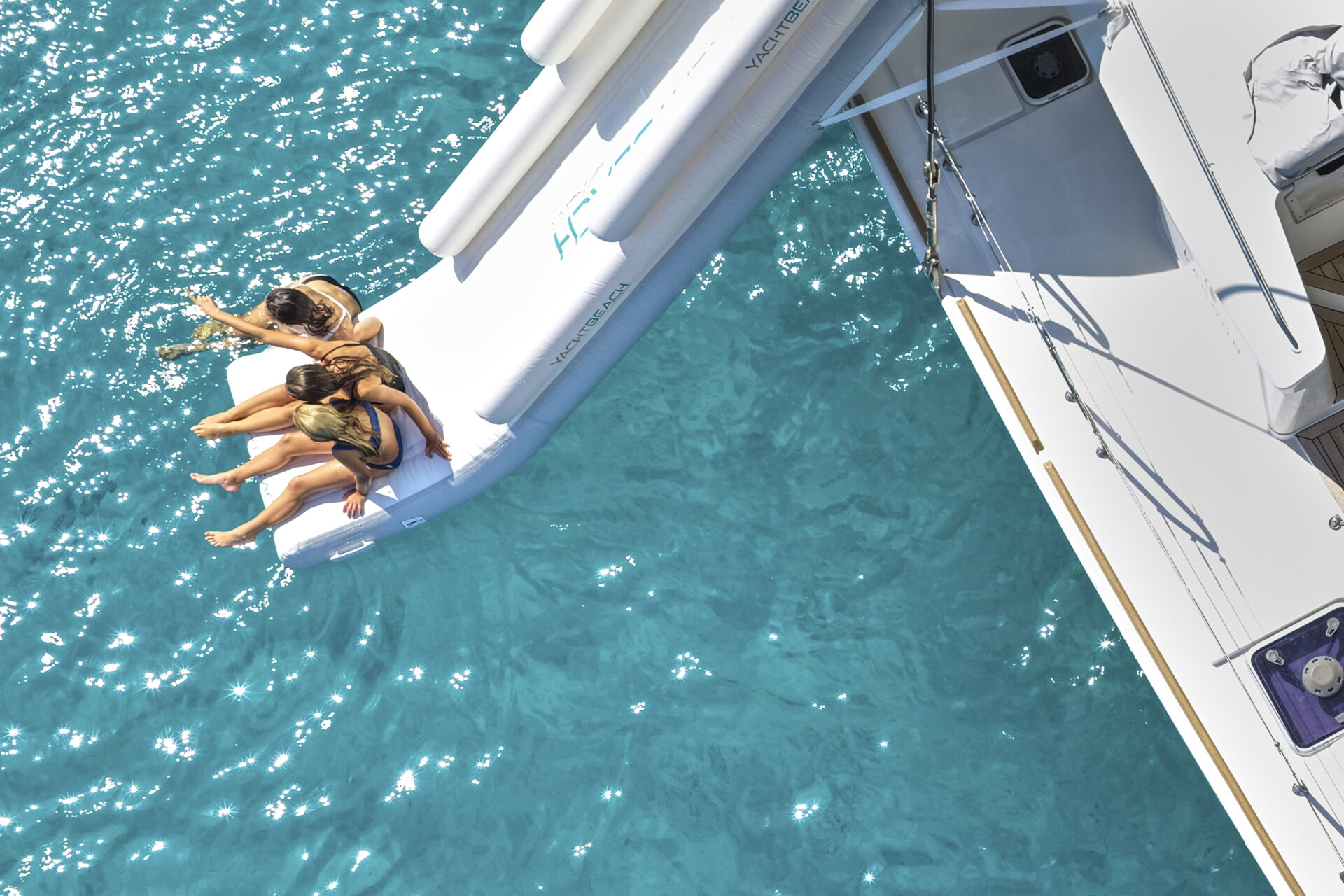
A few weeks ago I had a family on board — two parents, a boy of about ten, and a grandmother who’d told me at the marina she “wasn’t really a swimmer”. We dropped anchor over the deep middle of the bay, put the platform down, and the boy was in the water before the engines were off. Twenty minutes later it was the grandmother who didn’t want to come out. She’d put on a mask for the first time in her life, hung onto a float at the stern, and spent half an hour watching the fish move along the rock wall below her.
When she finally climbed back up she said the thing I hear more than any other here: “I had no idea you could see that much.” That’s the bay’s real trick — from the cliff road it’s a pretty photo; with your face in the water it’s a different place entirely, and you don’t need to be a strong swimmer to get it.
The mannequins on the seabed — a Guns of Navarone legend
Here’s the bit divers love. There’s a long-running local legend that, somewhere on the bottom of Anthony Quinn Bay, two mannequins dressed as German soldiers were left chained to the rock after the Guns of Navarone shoot in 1960 — props that supposedly never made it back to the production.
I’ve never seen them, and I’ve been swimming this cove for years. Most dive instructors I know treat it as a story polished by retelling. But guests still ask, divers still go looking — and the fact that people are still searching sixty-odd years later tells you something about the hold this little bay has on people.
What visitors keep saying
I read the reviews of my own coast — it’s how I know what people get wrong. Across years of visitor comments, the same notes come up again and again, and they’re all true:
“Go early — by mid-morning every lounger was taken and we moved on.”The most common regret in the reviews.
“Bring water shoes, the rocks are sharp and HOT getting to the water.”The single most repeated tip.
“Best snorkelling ever — clear, warm, calm, perfect for teaching the kids.”Why people come back.
“Don’t miss the cliff walk over to Faliraki — it should be in the island’s top ten.”The quiet local tip few guides mention.
Arriving by boat answers the first two for you: you’re there before the loungers fill, and you step off a platform, not over hot rock.
The honest bit: cliff vs water
Most people who “visit” Anthony Quinn Bay actually only ever see it from the road that curls along the cliff above. They pull in, take the photo everyone takes, and drive on — because the car park is small and full, the stairs down are steep, and by 11 am in August the strip of pebbles is shoulder-to-shoulder.
That’s not a knock on the bay. It’s a knock on how it’s usually reached. When we anchor offshore on the day cruise, we’re sitting in the part of the bay no land visitor occupies — the deep middle, over the best of the snorkelling, with the whole emerald wall in front of you and a swim platform two steps from the water. No parking, no stairs, no scramble for a pebble. You get the version of Anthony Quinn Bay that the photos promise and the car park rarely delivers.
How to get there
By car: From Rhodes Town, take the coastal road towards Lindos and follow signs for Kallithea, then Faliraki. It’s about 15–17 km and roughly 20 minutes. Parking is free but very limited and fills early in high season.
By bus or taxi: Regular buses run the Rhodes Town–Faliraki corridor; from Faliraki it’s a short taxi or a warm walk. Taxis from Rhodes Town are straightforward, but agree a return.
By boat: Several catamaran trips include the bay as a swim stop. Our day cruise (from €140) leaves Rhodes New Marina, anchors off the cove for a proper snorkel stop, and pairs it with the swim-through Afandou Cave and lunch on board — the two things you simply can’t do from the cliff.
When to go
The swimming season runs late May to early October, with sea temperatures around 26–28°C from July into September. For the bay specifically: June and September are the sweet spot — warm water, strong light, far thinner crowds. July and August are glorious but busy, so arrive before 10 am or come by sea. And mornings beat afternoons every time for water clarity and calm.
Make a day of it: what’s nearby
If you’re visiting by road, the bay sits in the middle of the best stretch of the east coast, so it pairs naturally with a few other stops:
Captain’s final word
Anthony Quinn Bay earned its fame honestly — it really is that beautiful, and the snorkelling really is the best on Rhodes. The only mistake visitors make is treating it as a viewpoint to photograph rather than water to get into. Whether you climb down the stairs or swim off a boat, get in the sea — that’s where the cove keeps its promise. If you want to do it the way I would, the day cruise is built around exactly this stretch of coast.
Day or sunset? Read the honest breakdown